
Cry Out and See!
10-27-2024Weekly Reflection©LPi — Father John MuirNear my house there is a school for the blind. Often, I see blind people learning how to navigate the world with only a walking stick, even on a busy street with roaring traffic. I’m amazed to see how adept and carefully they get around without sight. Nevertheless, often a sadness arises in me that he or she cannot see all the beautiful colors, images, and persons filling the world around them. Those days, I find myself deeply grateful for the basic privilege of sight.
READ MORE
Give of Yourself
10-20-2024Weekly Reflection©LPi — Father John MuirFrom a young age, I loved winning at sports. I confess that winning was a bit of an addiction. It was probably coming from a deep desire for attention and affirmation from others. Nevertheless, it was a driving motivation for me. Baseball, soccer, track, table tennis, and whatever else I could find was a chance to win. Competition was my obsession.
READ MORE
Lord, All I have is Yours
10-13-2024Weekly Reflection©LPi — Father John MuirThis week we hear of the man who inquires of Jesus how to obtain eternal life. He rejects Jesus’ invitation to sell his goods, give to the poor, and follow Jesus. Mark tells us this devastatingly sad line, “At this saying, his countenance fell and he went away sorrowful; for he had great possessions” (Mark 10:22). The man’s heart wasn’t centered on Jesus, but on his possessions. Perhaps Jesus intuited this. Now, we don’t know if Jesus intended to actually make him go through with it, like God’s call to test Abraham’s willingness to sacrifice Isaac. But sadly, in this case the willingness was not there to entrust everything to Jesus. And this made the man deeply sad.
READ MORE
Trust in the Lord
10-06-2024Weekly Reflection©LPi — Father John MuirAs a young pastor years ago, I met with a middle-aged couple who had been divorced and civilly remarried. They were frustrated that an annulment had to precede a Church marriage. Sympathizing with their plight, I promised to walk with them along their journey. Once as we sat in my office, the man said to me, “Why is the Church so difficult on marriage?” I replied, “Actually, Jesus’ teaching is what’s difficult.” He furrowed his brow and asked what I meant.
READ MORE
Repent and Be Free
09-29-2024Weekly Reflection©LPi — Father John MuirMaggots, grubs, worms. When I imagine one or many of these nasty slimy buggers living inside my body — unseen, feeding off my flesh, slowly rotting me out — I feel deeply disgusted. If I knew I had a worm, I would do anything to remove the alien invader, and fast. But what if I couldn’t ever get it out?
READ MORE
Welcome Jesus
09-22-2024Weekly Reflection©LPi — Father John MuirWhen I was a wet-behind-the-ears seminarian, I was sent for an immersion with the poor. For one month, I lived in a home for adults with developmental disabilities. It was a challenge for me because the residents had significant communication issues. A 30-year-old man there named Robin was totally deaf and mute. He had Down’s Syndrome. He looked like a Viking, with a shock of red hair and a fine beard. But I felt awkward and disconnected from him. All my normal ways of interacting failed. I resigned myself to the fact that we’d never connect.
READ MORE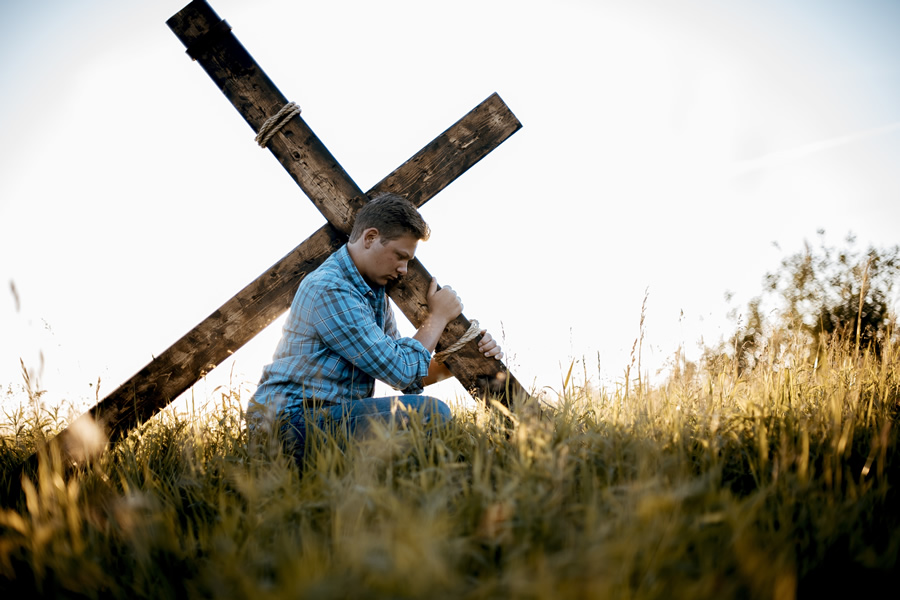
Take Up Your Cross
09-15-2024Weekly Reflection©LPi — Father John MuirThis morning I received a text message that a member of my extended family will likely die of cancer within the next few hours. His name is Luke. He is a 45-yearold husband and father of six. Though I am not as close to him as my sister (she is his sister-in-law and knows him well), I wonder: how can we, including Luke himself, manage such a terribly awful and unfair situation?
READ MORE
Be Opened
09-08-2024Weekly Reflection©LPi — Father John MuirOne of the most touching YouTube videos I’ve ever seen is one in which a deaf woman receives new technology to heal her hearing. She hears her husband's voice for the first time — and her own, too — and bursts into tears of overwhelming joy. It must have been like an immovable wall between her and her loved ones came tumbling down.
READ MORE
The Heart of Purity
09-01-2024Weekly Reflection©LPi — Father John MuirPurity isn’t popular at the moment. Or is it? Look at a rack of health magazines or at popular podcasts. You’ll see an infinite ocean of regulations and rituals of diets, intermittent fasting, morning sun rituals, intense juice detox practices, lists of dangerous foods, mental practices, as well as long lists of dos and don’ts for the proper cleaning of clothes, dishes, cars, houses, pets, and children. Like it or not, we long to be pure, clean, and without blemish.
READ MORE
A Love so Great
08-25-2024Weekly Reflection©LPi — Father John MuirThe famous Russian novelist Fyodor Dostoyevsky said, “Love in action is a harsh and dreadful thing.” In the Gospel reading this week, Jesus does something harsh and dreadful — he watches his own disciples abandon him. What could possibly be loving about that?
READ MORE
Not By Faith Alone
08-18-2024Weekly Reflection©LPi — Father John MuirA priest I know was asked by a door-to-door evangelist, “Do you believe in Jesus?” He answered, “Yes, I do. But if I may ask you,” he continued, “Where do you experience Jesus’ body and blood?” His interlocutor responded somewhat confusedly, “I don’t. I just believe in him. That’s all that is needed.” Later my priest friend would relate to me, “The more I thought about it, that response struck me as totally inadequate. As human beings, we need to encounter Jesus’ body and blood, not just hear about him and mentally believe. Otherwise, Jesus is just a ghost.”
READ MORE
Believe
08-11-2024Weekly Reflection©LPi — Father John MuirThis week we hear Jesus say, “He that believes in me, has eternal life” (John 6:47). These straightforward words, uttered by human lips, sound — how to put this? — insane. Who could possibly say such a thing? Jesus says things that are so high, so demanding, so beyond our capacity to fathom, we hardly know what to do with them and (if you’re like me), they usually go in one ear and out the other. So, let us ask: how can believing in him lead to eternal life?
READ MORE
Hunger and Thirst for God Alone
08-04-2024Weekly Reflection©LPi — Father John MuirSince my college days I’ve loved a song called “Dance with You” by the rock band Live. It touches on the deep mystical hunger of our heart: “I’ve tasted all the wines/ a half a billion times/ came sickened to your shore/ you showed me what this life is for.” These lines resonate with anyone who has feasted on the good things of this world only to be left spiritually hungover and unsatisfied.
READ MORE